What Is Microteaching, and Why Most B.Ed Colleges Still Can't Scale It
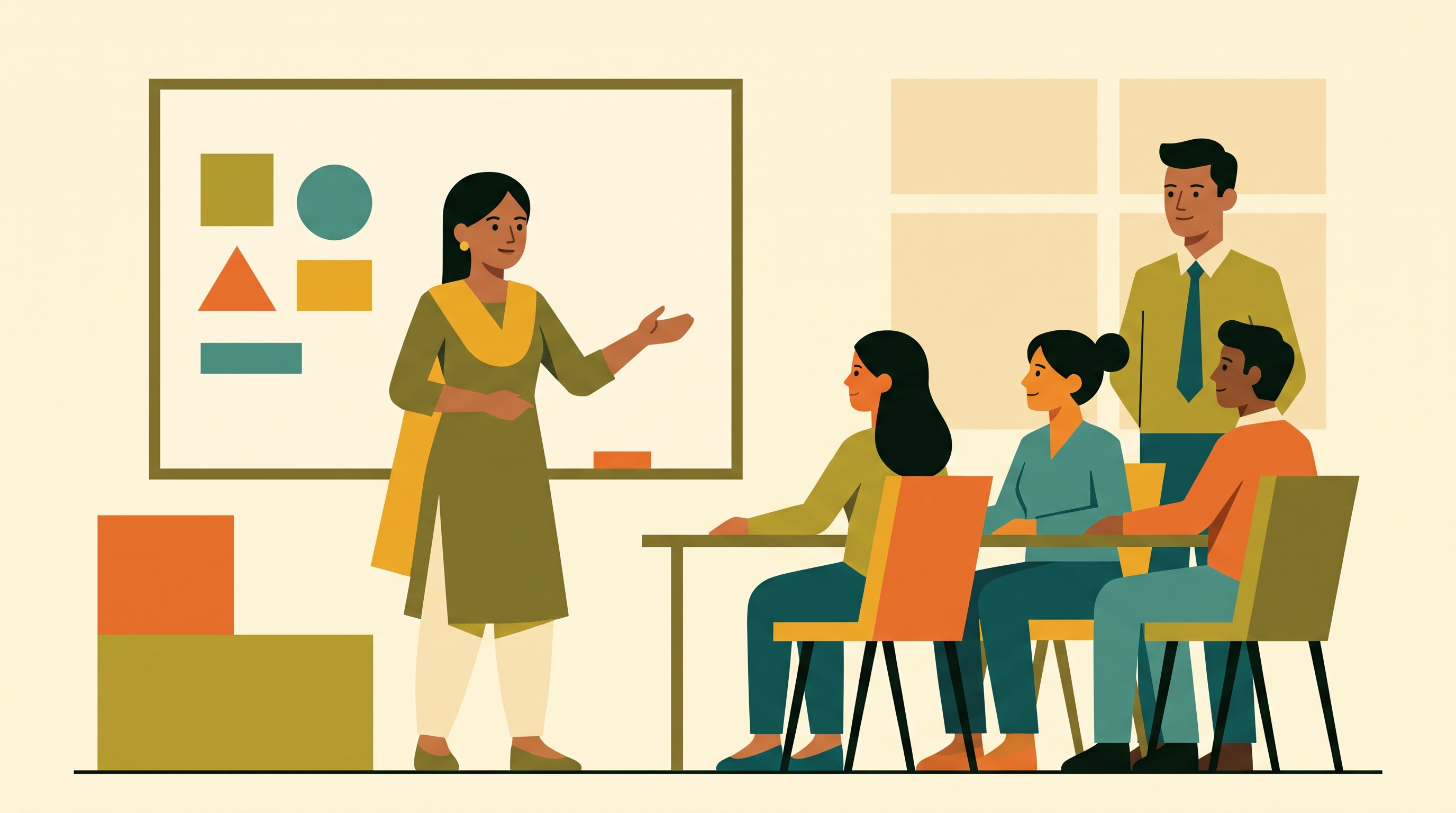
Every B.Ed and ITEP programme in India teaches microteaching — a trainee delivers a short, tightly scoped lesson segment to a small group, then reviews it with a supervisor. It is the single most-used method for building classroom skill before a real posting. It is also the method almost every college struggles to give enough of.
The bottleneck: microteaching only works if a trainee gets to repeat it — and most colleges can give each student only a handful of supervised turns a term, because supervision doesn't scale the way a lecture hall does.
What microteaching actually is
Microteaching was designed specifically because full-length lesson observation gives too little specific feedback. Instead of watching a 40-minute class once, a trainee practices one skill at a time in a short segment: set induction, explaining a concept, questioning technique, stimulus variation, reinforcement, or closure. The short cycle is the point — teach, get feedback, teach the same segment again, immediately.
Why most colleges can't scale it
That repeat cycle is exactly what's hard to deliver at scale. Three constraints show up in almost every programme:
Faculty time: one supervisor can realistically give real feedback on a handful of five-minute segments per session, not the dozens of repetitions a skill actually takes to settle.
Video-review backlog: recorded microteaching sessions often wait days for written feedback, by which point the trainee has moved on to the next assignment.
Room and AV scheduling: every supervised session needs a booked slot, which caps how often any one student can practice regardless of how much they want to.
What a modern skill lab adds
A practice lab doesn't replace the supervisor — it changes what the supervised sessions are for. Students can run the tenth and twentieth repetition of a segment on their own time, so the faculty member's limited hours go toward the repetitions closest to the actual teaching practice posting, not every single one.
Dimension | Traditional microteaching | With a practice lab added |
Repetitions per student | A handful of supervised turns a term, set by the timetable | As many as the student needs, on their own schedule |
Feedback turnaround | Often days later, after video review | Immediate, on every repetition |
Faculty hours required | Scales linearly with every repetition | Reserved for the repetitions closest to the real posting |
Where this fits under NEP 2020 and the ITEP framework
The four-year Integrated Teacher Education Programme rolled out under NEP 2020 spreads practical training earlier and more continuously across the degree, rather than concentrating it in a final-year block — which raises, not lowers, the number of repetitions a programme needs to supply. NIPUN Bharat's foundational literacy focus adds a similar pressure for primary-stage trainees specifically, where early classroom-management and questioning practice matters most.
Frequently asked questions
Does a practice lab replace faculty supervision?
No. It doesn't replace the supervised sessions the curriculum requires; it changes what a trainee brings to them. Students arrive having already run the lesson several times, so the supervisor's feedback goes toward refinement rather than a first attempt.
Which microteaching skills does this apply to?
Set induction, questioning, stimulus variation, explaining, reinforcement, closure, classroom management, handling a difficult parent conversation, and responding to child-development and psychology situations — the core skills B.Ed practice teaching is built to test.
Is this specific to B.Ed, or does it apply to ITEP as well?
Both. ITEP's four-year structure just means the repetitions need to start earlier in the programme and continue longer.
Conclusion
Microteaching isn't the part of teacher education that needs replacing — it's the part that needs more room to repeat. Skill labs exist to give it that room without adding faculty hours colleges don't have.