Case Study: Managing High Stakes Conversations In Law
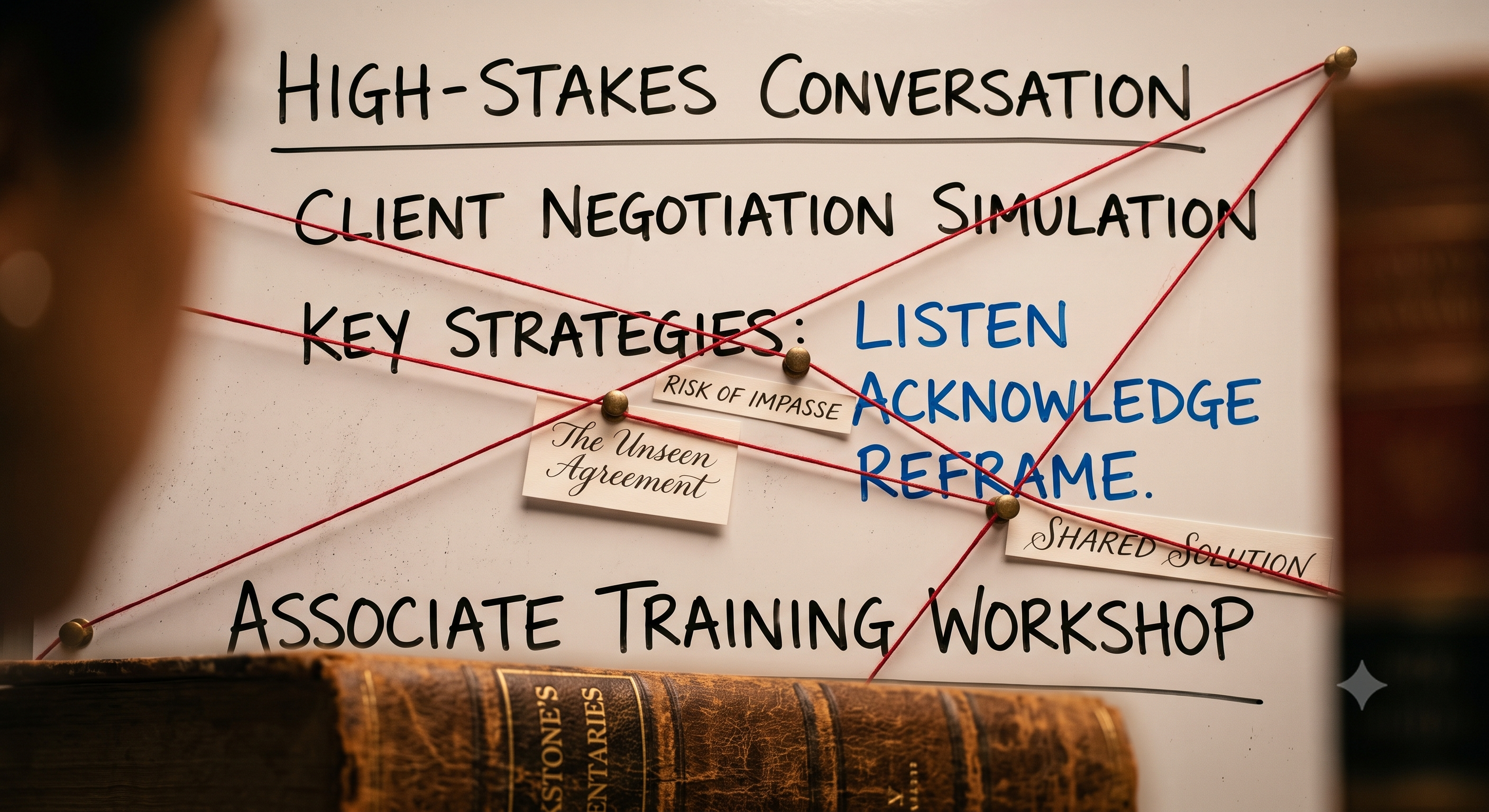
The most effective approach to managing high stakes conversations in the law workplace is replacing passive observation with active simulated practice. Junior associates often struggle not because they lack legal knowledge, but because they have never had to deliver difficult news or negotiate terms out loud under pressure. Building behavioral readiness through targeted repetition closes this gap before they interact with real clients.
Key takeaway: The fastest way to prepare junior lawyers for sensitive client meetings is to shift training from passive shadowing to active simulation, allowing them to build muscle memory and confidence in a safe, controlled environment.
The readiness gap in legal associate training
Traditional legal associate training leaves a readiness gap because reading case files and watching senior partners does not wire the brain for independent verbal action. Many learning and development heads find that new graduates possess excellent analytical skills but struggle to defuse an angry client or communicate complex risks.
Behavioral readiness is the measurable ability of a professional to execute theoretical knowledge verbally under pressure. Unlike cognitive knowledge, which relies on memory, behavioral readiness relies on active muscle memory developed through repeated real world application.
Shadowing senior partners creates a false sense of security. Associates absorb the outcome but miss the subtle micro adjustments the senior partner made during the conversation. To fix this, ask associates to debrief not just on what the partner achieved, but exactly which phrases the partner used to de escalate tension. This shifts their focus from legal theory to practical communication mechanics.
Role play has limitations. It works best for preparation anxiety and baseline skill acquisition. It is not a replacement for genuine experience or managing the unpredictable elements of live courtroom litigation. Relying solely on simulations without real world application will leave associates underprepared for highly irregular client behavior.
A case study on managing high stakes conversations in the law workplace
Tracking active practice sessions reveals that structured repetition significantly reduces anxiety when managing high stakes conversations in the law workplace. Firms that implement daily micro practice sessions see a sharper decrease in associate hesitation during client calls compared to those relying entirely on observation.
Theoretical exams test memory, while client calls test composure. The gap between knowing the law and explaining the law to a hostile audience requires a different set of cognitive tools. Associates need to learn how to tolerate uncomfortable silence and set clear boundaries without over explaining their position.
When evaluating how to close this gap, many firms turn to scalable platforms like Teachrity to standardise how associates practice these sensitive interactions. Providing a safe environment where lawyers can stumble without risking a client relationship accelerates their path to competence.
This approach yields tangible results for firms willing to invest in active practice.
Firms looking to expand this approach can explore further strategies in our practical education for new hires guide.
How law practice simulations build communication skills
Effective law practice simulations isolate specific conversational triggers so associates can practice their responses repeatedly. Instead of a general sixty minute mock negotiation, junior lawyers benefit most from five minute drills focusing entirely on delivering bad news or boundary setting.
Cognitive load is highest in the first three minutes of a difficult conversation. Practicing the opening statements specifically reduces filler words by giving the brain time to structure a response before speaking. This targeted practice wires the brain to default to a calm, measured tone when confronted with aggression or pushback from a client.
You can facilitate this manually by having pairs of associates run rapid fire drills using index cards with specific client objections. For firms needing more scale, a common application involves using the Teachrity AI Scenario Builder. L&D leaders input specific client archetypes, allowing associates to run adaptive AI conversations that push back on legal advice, providing instant feedback on their tone and clarity.
For additional context on structuring these scenarios, review this expert guide on legal communication models.
Decision framework for client negotiation role play
Choosing the right client negotiation role play format depends on the specific behavioral gap your associates demonstrate. Match the practice method directly to the type of hesitation they show in meetings to ensure your training hours yield actual results.
If you are training first year associates who freeze when clients push back, use scripted micro drills. If you are preparing mid level associates for complex settlements, use adaptive unscripted simulations.
Training Need | Hesitation Type | Recommended Method |
Delivering Bad News | Softening the message | Scripted Micro Drills |
Setting Boundaries | Over explaining | Time Limited Scenarios |
Complex Settlements | Yielding too quickly | Adaptive Simulations |
Structuring training around these specific gaps ensures that associates develop targeted communication skills rather than just general confidence.
Frequently Asked Questions
What is the biggest challenge in legal associate training?
The biggest challenge is moving from cognitive understanding to verbal execution. Associates often know the legal statutes perfectly but freeze when a client demands immediate answers. Traditional training relies heavily on passive observation. This approach fails to build the necessary muscle memory for speaking under pressure. Active vocal repetition is required to bridge this gap.
How do you measure communication skills in law practice?
You measure these skills by tracking the reduction of filler words and hesitation markers during live simulations. A confident associate will maintain a steady pace when delivering difficult news. Evaluators should watch for the ability to hold silence after stating a boundary. Metrics should focus on behavioral responses rather than just legal accuracy.
Why do law practice simulations work better than reading transcripts?
Simulations force the brain to process information and generate a verbal response simultaneously. Reading transcripts only engages the analytical part of the brain. When associates speak out loud, they expose their conversational crutches and pacing issues. Recognizing these habits in real time allows for immediate correction. This active engagement creates lasting behavioral change.
How often should associates practice client negotiation role play?
Associates see the best results when they practice in short increments two to three times a week. A five minute targeted drill builds confidence faster than a single hour long session once a month. Frequent repetition lowers the cognitive load required to start difficult conversations. Consistency is far more valuable than duration.
Can AI simulations replace senior partner shadowing?
AI simulations are designed to complement shadowing rather than replace it entirely. Shadowing provides crucial context for complex firm specific strategies. Simulations provide the safe environment needed to practice the exact phrases the senior partner used. Associates need both the model to follow and the space to practice executing it independently.
Conclusion
Transitioning your associates from theoretical experts to confident practitioners requires an environment built for safe failure. Platforms like Teachrity provide the realistic role play needed to build behavioral readiness before those crucial client meetings happen. For more insights on measuring the success of these programs, review our research on training outcomes.